A pipe or appliance let go
Sudden, accidental discharge — a burst supply line, a failed water heater, a washing machine hose — is the classic covered cause under most Florida policies.
 PURE SHIELD
Most water damage jobs we do become an insurance claim. Here's what's typically covered, what usually isn't, and what we document on every job so your claim is decided on evidence instead of memory.
If any of these sound familiar, it's worth a free inspection.
Sudden, accidental discharge — a burst supply line, a failed water heater, a washing machine hose — is the classic covered cause under most Florida policies.
Two policies and often an association are involved. Whose carrier pays depends on the cause and the governing documents, which is exactly why the documentation matters.
What's already been dried, torn out or thrown away can't be inspected. Photographs and moisture logs taken before the work are what stand in for it.
Denials often turn on cause and timeline. A written scope with dated moisture readings gives you something concrete to go back with.
Long-term seepage is usually excluded as a maintenance issue. It's still worth an honest look — sometimes the cause is more sudden than it appears.
Wind-driven rain, storm surge and groundwater flooding are treated very differently. Which one you had decides which policy applies.
Photographs of the loss as found, moisture readings across affected and unaffected areas, and a note on the apparent cause and how far water traveled.
Every policy obliges you to prevent further damage. Extracting and drying promptly protects the claim as well as the house.
Daily moisture readings on each affected material until the structure is verified dry. That log is the record that the work was necessary and complete.
A line-item scope of what was removed, dried and treated, in the format carriers expect, with the photographs attached.
We'll walk the loss with your adjuster, explain what's behind the wall, and answer the technical questions so you don't have to relay them.
If the claim calls for independent mold assessment or a clearance sample, we bring in a third-party licensed assessor, which keeps the testing at arm's length from the remediation.
By the time an adjuster looks at a water loss, the water is gone. The drywall is out, or it’s been dried, or it’s been painted. The thing they are being asked to evaluate no longer exists in the state it was in.
That’s why documentation is not paperwork. It’s the evidence. Photographs of the loss as found, moisture readings that show how far the water actually traveled, and a dated drying log are what stand in for the damage itself once the damage has been dealt with.
It also cuts the other way. Good documentation protects you from being paid for less than the loss, and it keeps an honest contractor from being accused of doing more work than the job needed.
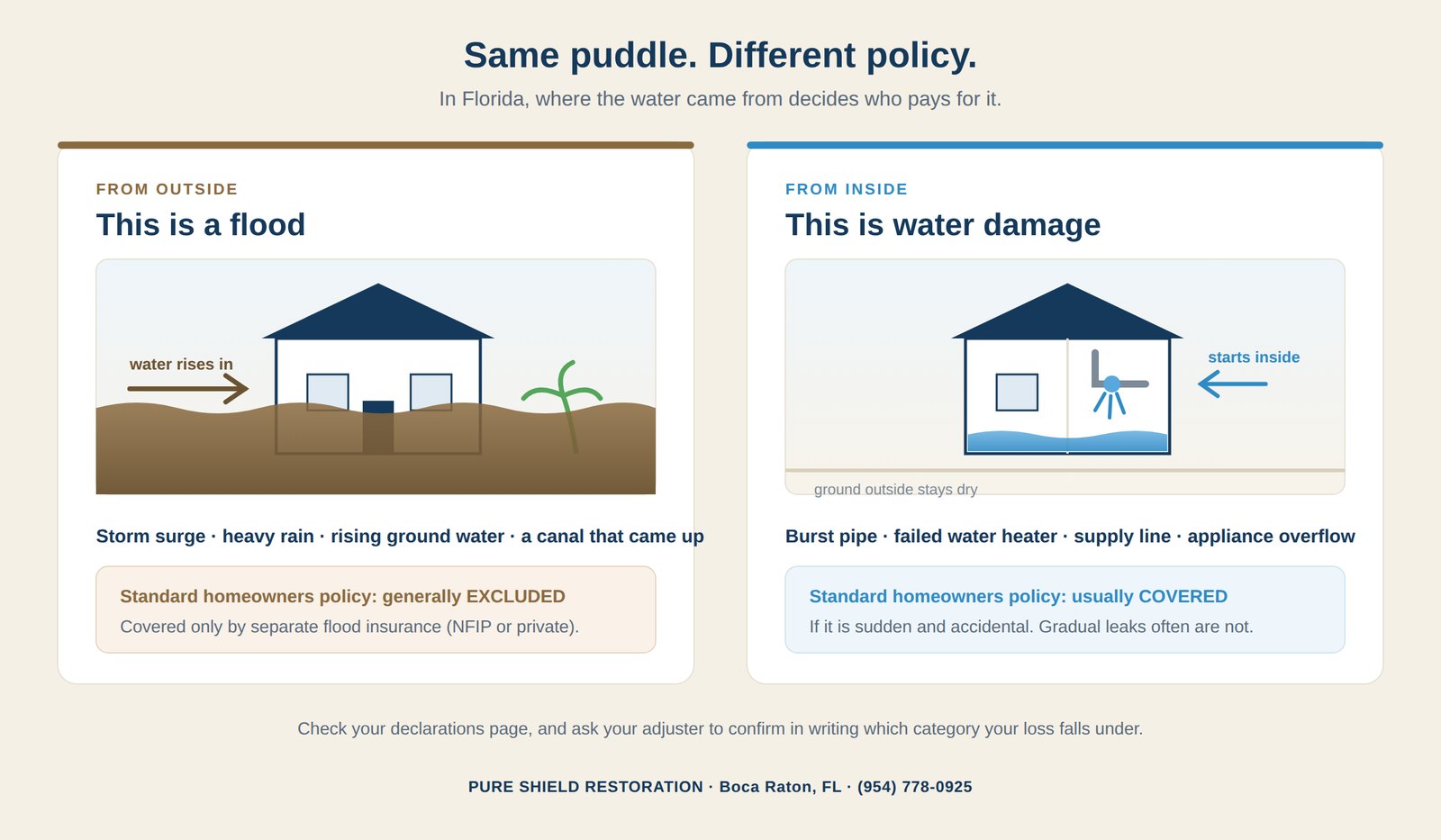
Three rough categories, and the line between them is the cause.
Usually covered is the sudden, accidental discharge of water inside the building. A supply line bursts. A water heater fails. A washing machine hose splits. A toilet supply or an ice maker line lets go. Something happened, it happened quickly, and it wasn’t the result of neglect.
Usually not covered is gradual damage. A fitting that has been weeping for a year. A shower pan that has been leaking into the subfloor since before you bought the house. The reasoning carriers apply is that you had the opportunity to notice and address it. This is where most disputes live, because “gradual” is a judgment call and the evidence for it is often ambiguous.
Not covered under a homeowners policy at all is flood — water that rises from outside and comes in at ground level. Storm surge, a canal over its banks, street flooding after a heavy rain. That requires separate flood coverage through the NFIP or a private carrier. Wind-driven rain that enters through a storm-created opening is a different animal and is often handled under the homeowners policy, which is why the distinction matters so much in South Florida. We wrote about that difference in more detail here.
This is the single most common unpleasant surprise we see.
Many Florida homeowners policies cover mold remediation arising from a covered water loss, but cap it — a specific dollar limit for mold, separate from and much lower than your dwelling coverage. The cap applies no matter what the remediation actually costs.
It’s on your declarations page, usually under fungi, mold or microbial matter. It takes thirty seconds to find and it’s worth knowing now rather than in the middle of a claim. Some carriers will sell you a higher limit for a modest increase in premium.
Nearly every property policy includes a duty to mitigate: an obligation to take reasonable steps to prevent the loss from getting worse after it happens.
In practice that means the clock on drying starts before the claim does. Mold growth on wet materials typically begins within 24 to 48 hours. If drywall stays saturated for four days waiting on an adjuster’s schedule, the additional damage from those four days is damage you may end up arguing about.
Stop the source. Extract the standing water. Get air moving and the structure drying. Photograph all of it as you go. Then report the claim. Doing it in that order protects both the house and the claim.
Don’t throw anything away. Damaged flooring, cabinetry, baseboard, personal property — if it has to come out, it comes out, but photograph it first and keep it somewhere accessible if you can.
Don’t have it repaired before it’s inspected. A repaired ceiling is an uninspectable ceiling.
Don’t say the leak has been there a while unless you know that. People say it reflexively, out of a sense that they should have caught it sooner. It’s a statement about cause, and cause is what coverage turns on. Describe what you observed and when you observed it.
Don’t dry it and say nothing. Mitigation work performed without documentation is very hard to get reimbursed for.
We’re a restoration contractor, licensed for mold remediation in Florida under MRSR5407 and IICRC certified. On a claim, our part is the technical part: document the loss properly, do the mitigation and remediation work, produce a scope and a drying log that a carrier can act on, and explain the building science to your adjuster so you aren’t in the middle relaying it.
What we are not is a public adjuster or an attorney. We don’t interpret your policy, we don’t decide your claim, and we don’t negotiate it on your behalf. If a claim is denied or underpaid and you want it challenged formally, a licensed Florida public adjuster or an attorney is the right call, and we’ll hand over every photograph, reading and scope document we have.
We also won’t tell you to file. On a small loss, the repair may not be far enough above your deductible to be worth a claim in this market. You’ll have an honest number from a free inspection before anything starts, and the decision stays yours.
Call (954) 778-0925. We answer 24/7, and for an active water emergency the right time to call is now, not after the adjuster gets back to you.
Recent water and mold work, photographed and metered the way a claim needs it.
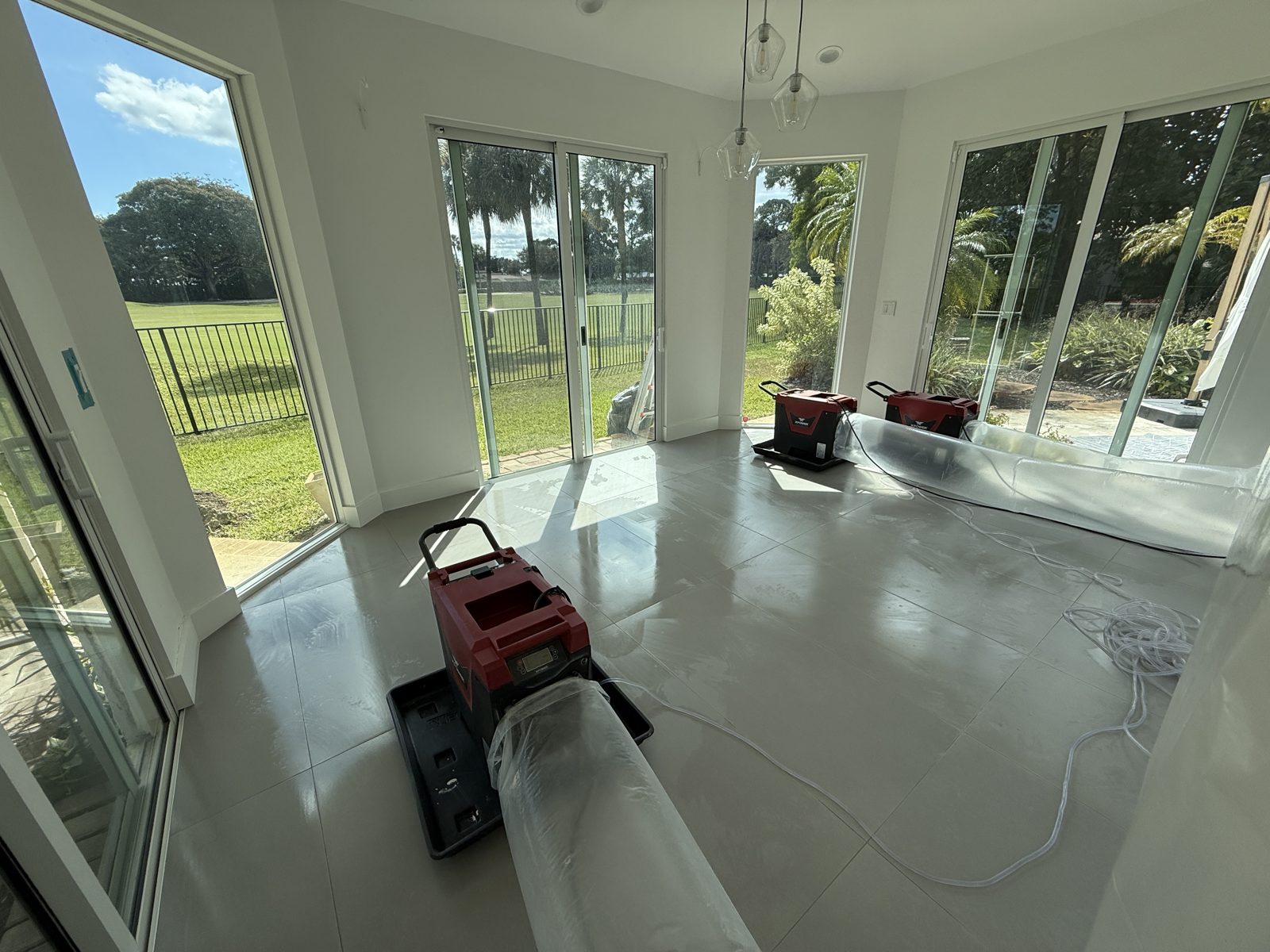
Water intrusion in a newer open-plan Coral Springs home. We contained the affected wall, ran ducted drying …
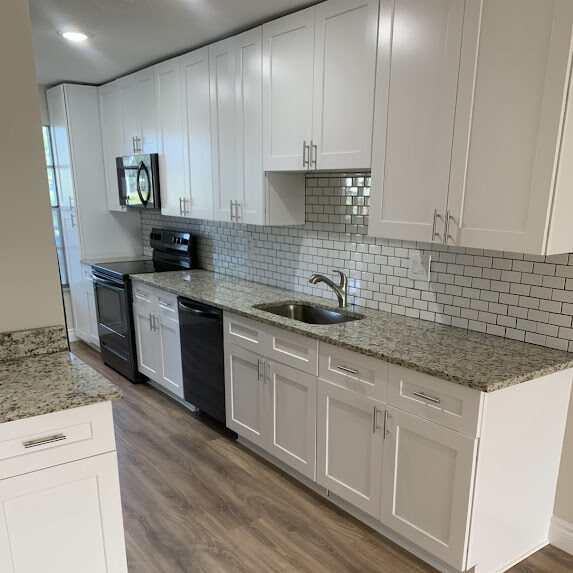
An upstairs condo leak flooded a 55+ community kitchen in Delray Beach. We dried it, removed the damaged …
Usually, when the cause is sudden and accidental — a burst pipe, a failed supply line, a water heater that lets go, an overflowing appliance. What's generally not covered is damage from long-term seepage, wear and tear, or lack of maintenance, on the theory that you had the opportunity to catch it. Flooding from groundwater or storm surge is excluded from standard homeowners policies entirely and requires separate flood coverage. Every policy is different, so read yours or ask your agent — we're restoration contractors, not adjusters, and we won't tell you what your policy says.
It depends almost entirely on what caused it. Mold that results from a covered water loss is often covered, though many Florida policies cap mold remediation at a set dollar limit regardless of the actual cost. Mold from a gradual leak, humidity, or deferred maintenance is typically excluded. Check your declarations page for a mold or fungi sublimit — it's frequently a five-figure cap that people don't know they have until they need it.
Call whoever stops the damage first, then the carrier. Most policies include a duty to mitigate — an obligation to take reasonable steps to prevent the loss from getting worse. Waiting several days for an adjuster while drywall stays wet can itself become a reason for a reduced payout. Get the water out, get the structure drying, document everything, and report the claim as soon as you reasonably can.
Photographs of the damage as it was found, before anything was removed. Moisture readings showing how far the water travelled, including readings in unaffected areas for comparison. A daily drying log. A line-item scope of what was removed, dried and treated. Receipts for emergency expenses. If materials were removed, photographs of what was behind them. We produce all of that on every job as a matter of course.
Yes. We document to carrier standards, write the scope in the format adjusters expect, and will walk the loss with your adjuster to explain the technical side. What we don't do is decide your claim or negotiate it for you — that's between you and your carrier, and if a claim gets contested, a licensed public adjuster or an attorney is who handles that side.
Denials usually turn on cause or on timeline — the carrier's position is either that the cause was excluded or that the damage was gradual. Both are factual questions, and both are easier to challenge with dated photographs and moisture data than with recollection. You have the right to request the denial in writing with the specific policy language it relies on. If you want it pushed back on formally, that's a public adjuster or an attorney's job, not ours.
It can, and in the current Florida market it sometimes affects renewal as well as price. That's a real consideration on a small loss where the repair cost isn't far above your deductible. We'll give you an honest estimate before any work starts so you can make that call with a real number in front of you rather than a guess.
Tell us what's going on and we'll get right back to you. For active emergencies, we answer 24/7.
(954) 778-0925