 PURE SHIELD
Black mold is handled the exact same way as any other indoor mold because the color of the growth does not change the physical removal process. The real problem facing your home is the hidden moisture source and the structural damage you cannot see.
Finding water inside your house is incredibly stressful. You are left wondering what your insurance covers, who you can trust to give you an honest answer, and how much disruption your family will face.
The Environmental Protection Agency sets a very clear guideline to help you gauge the severity of the situation. Small areas of mold measuring under ten square feet on hard, non-porous surfaces can often be cleaned safely by a homeowner. However, when the growth is larger than that, hides inside a wall cavity, or connects directly to an active plumbing leak, you need a professional to intervene. We are going to break down exactly where this moisture hides in local homes, how professional remediation works, and when you can handle a small cleanup job safely on your own.
The most common sign of a mold issue in a kitchen is a persistent musty smell near the lower cabinets, rather than obvious visible growth on the doors or walls. We see this exact scenario frequently during our mold removal in Deerfield Beach. On one recent job detailed in our Deerfield Beach kitchen mold records, the root cause was a slow leak running along the back of the kitchen cabinet line. Water never dripped onto the floor, and nothing ever pooled where anyone could see it. Instead, the moisture slowly wicked into the drywall and fed microbial growth entirely inside the wall cavity behind the lower cabinets.
Handling a situation like this means opening up the wall behind the counter to reach the actual source of the problem. You cannot just wipe down the visible surfaces and hope the smell goes away. On that project, we protected the floors and walkways, removed the affected drywall and porous cabinet materials, and treated the cavity. We also extracted the moisture and dried the area as we went, ensuring the water left the house along with the damaged materials. The kitchen was completely dried and verified before any finishes were closed back up.
The wet spot you see on your ceiling is usually not the full extent of the damage, but just the small part of the damage that finally soaked through to the paint. In our region, many homes are two-story properties where the air handler sits in the attic above finished ceilings. We recently completed a project involving ceiling mold from an attic AC leak in Parkland, documented in our Parkland attic AC leak case file. The issue started with just a small water stain over a bathroom, right beside a recessed light. AC condensate drain lines in the attic rarely burst. Instead, they clog with algae and dust, or a PVC fitting weeps slowly. Water leaves the drain pan a little at a time and sits on the back of the ceiling in a warm, dark, and humid environment.
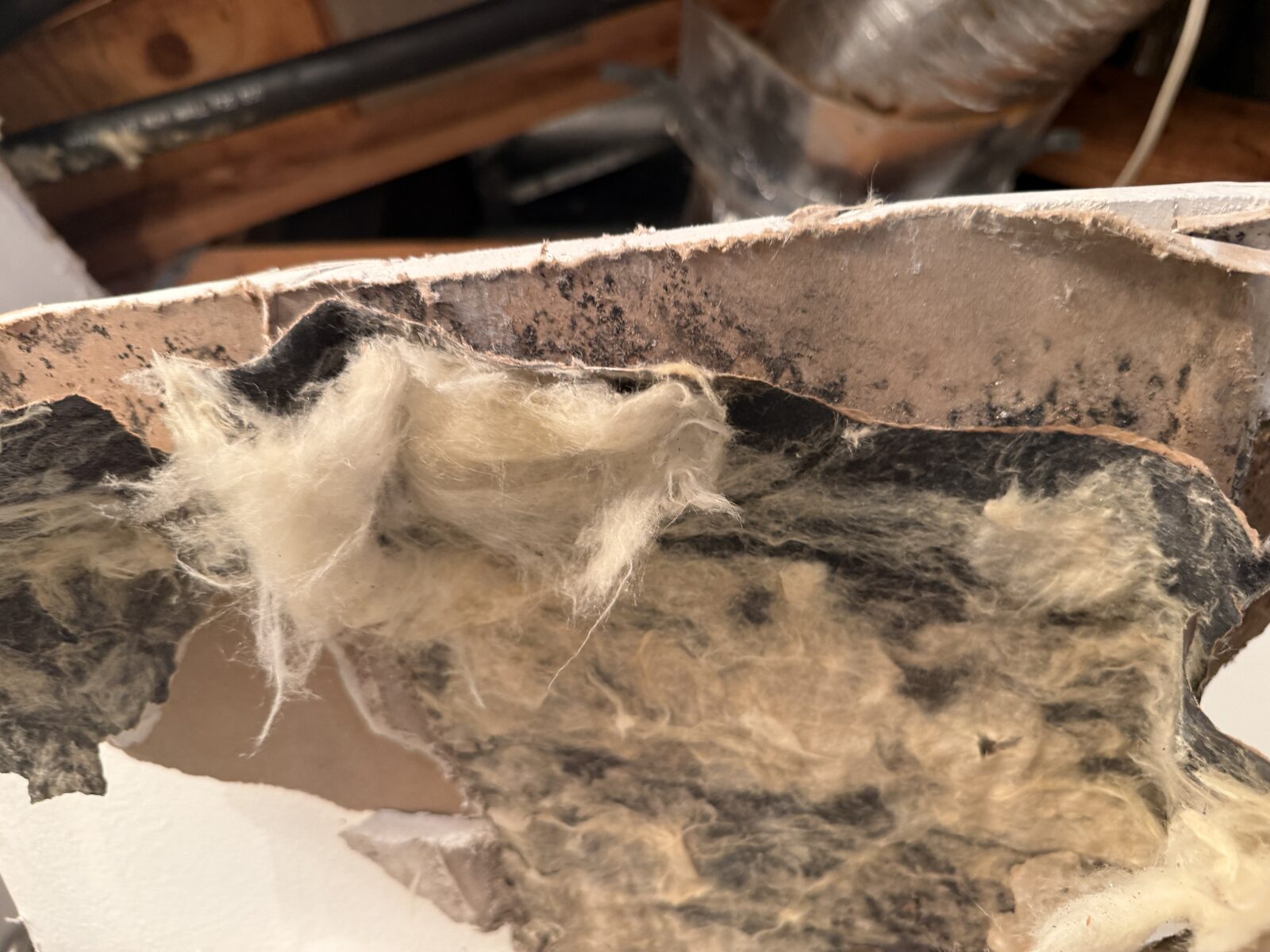
On this job, we started our assessment with a moisture meter instead of a saw. The moisture readings ran far past the boundaries of the visible stain. We made small exploratory ceiling cuts before committing to large removal. This exploratory step is the one most often skipped by untrained workers, and skipping it is exactly how wet ceilings get patched over active growth. We found growth on the back of the ceiling stretching across an area much larger than the stain, which had carried up into the exposed wood framing and left the insulation wet. We removed the affected ceiling material because porous drywall cannot be cleaned once roots take hold. We HEPA vacuumed the framing and mechanically sanded the wood. Framing can usually be saved, but it must actually be cleaned, not just sprayed with chemicals. After treating and verifying the wood was dry, we sealed the framing and installed temporary poly sheeting until the rebuild could begin.
Black mold behind condo drywall often originates from a slow hot water leak in the unit directly above yours. We managed a complex bathroom mold removal project involving black mold behind condo drywall in Boca Raton, detailed in our Boca Raton condo mold records. A hot water line leak from the upstairs neighbor soaked the shared wall. Dark staining only appeared on the drywall after the moisture had already taken a strong hold behind the paint. The water wicked down through the drywall and into the baseboards. This fed heavy growth across the wall, wrapping around the bathroom vanity, behind the toilet, and extending near the laundry area.
Using advanced moisture meters, we traced exactly how far the water traveled behind the finishes. We set up full containment to seal off the affected rooms and ran HEPA air scrubbers. We removed the drywall and materials that the spores had rooted into. We then HEPA vacuumed the remaining surfaces and applied an antimicrobial treatment throughout the wall cavity. In a multi-family building, keeping the work perfectly contained is mandatory. We ensured nothing was tracked into the shared condo hallways, and no airborne dust was pushed into adjacent units. We also successfully managed a Delray Beach condo water damage job recently with similar upstairs leak issues, handling the drying and the insurance claim end to end. Upstairs leaks like this come up constantly in the 55+ condo communities we serve for mold and water damage in Delray Beach.
Coastal humidity easily feeds microbial growth in closed-off spaces where your air conditioning does not circulate well. In South Florida, spare bedrooms and guest closets are often kept shut for weeks at a time. These are rooms nobody walks through daily. The air grows stagnant, humidity rises, and small roof leaks or window seal failures have plenty of time to spread moisture. By the time you open the closet door and spot dark growth on your clothes or the drywall, the environment has been damp for a long time. Maintaining proper airflow and checking these quiet rooms regularly is vital for catching water intrusion early.
Professional mold removal is a highly controlled process of capturing airborne spores while physically removing contaminated materials down to clean framing. It is not about spraying chemical treatments on a wall and hoping the problem disappears. On every single job we take, our owners are on site, and we follow a strict sequence: Detect, Contain, Remove, Dry, and Restore.
First, we detect the moisture source using thermal cameras and moisture meters to map the exact boundaries of the wet materials. Next, we contain the area. During a recent Pompano Beach containment remediation, we worked in an immaculate, occupied home. The job was as much about protecting the rest of the house as it was about remediation. We sealed zip-wall containment around the work area. We taped filtered panels into the barriers and ran HEPA air scrubbers under negative pressure the entire time. This negative pressure meant that air only moved into the containment zone, never out into the clean living spaces. We put down full floor and walkway protection along every crew path.
With the area secured, we remove the damaged drywall, trim, and flooring down to clean material while the HEPA scrubbers run constantly. We then dry the underlying structure using commercial air movers and dehumidifiers. We check the progress daily until our meters read that the wood and concrete are completely dry. Finally, we perform a final clean and walkthrough. Most homes take about three to five days from start to verified dry. The ultimate goal is to hand the home back looking like we were never there.
You can safely clean small patches of surface mold on hard materials using a simple mix of household detergent and warm water. If you find a tiny spot of mold on bathroom tile, shower glass, or metal hardware, you do not need to panic. The EPA notes that areas measuring under roughly ten square feet on hard, non-porous surfaces can usually be handled safely by a homeowner without professional help.
Before you begin cleaning, you must protect yourself. Wear an N95 respirator, thick rubber gloves, and safety goggles that do not have ventilation holes. Scrub the hard surface thoroughly with the detergent and water mixture, and allow it to dry completely. A major mistake homeowners make is assuming highly aggressive chemicals are required for cleanup. The EPA does not recommend bleach as a routine practice. If you do choose to use bleach on your bathroom tile, you must absolutely never mix it with ammonia or other household cleaners, as this creates highly dangerous fumes. Another critical rule is to never paint or caulk over mold. Paint will just peel, and the growth will continue eating through the material underneath.
Any mold removal project larger than ten square feet in the state of Florida requires a licensed professional to perform the work legally. The state regulates this industry heavily to protect homeowners from improper practices. You should always verify a contractor’s Florida Department of Business and Professional Regulation (DBPR) mold license number before allowing anyone to cut into your walls. Pure Shield Restoration holds Florida mold remediation license MRSR5407, and we are fully certified.
Florida law also mandates a strict separation between mold assessment and mold remediation. The company that tests your home and writes the protocol is not legally permitted to perform the actual removal work on that same job. This law prevents a conflict of interest where a company might invent a problem just to charge you to fix it. We are strictly a remediation firm, focusing entirely on removing the damage safely, properly, and honestly.
Finding water damage inside your house is incredibly frustrating, but the recovery process is straightforward when handled correctly. From managing slow kitchen leaks to full black mold removal in Pompano Beach, the key is always finding the hidden water source first. If you are dealing with a leak or suspect a hidden problem in Coral Springs or Boca Raton, our owners are on every job and ready to help you assess your home honestly and effectively.
If the growth is on a hard, non-porous surface and covers less than ten square feet, you can usually clean it yourself with detergent and water. If the growth is larger, hides inside a wall cavity, affects porous materials like drywall or insulation, or stems from an active plumbing leak, you need professional black mold removal.
Detergent and water is the recommended approach for hard surfaces. Vinegar can sometimes help clean non-porous surfaces, but the EPA explicitly states that bleach is not recommended for routine cleanup. Bleach often just removes the dark color on porous surfaces without actually extracting the root system.
Attic mold is a serious structural issue that can compromise your roof decking and ceiling joists if left ignored. It is not a situation a homeowner can fix alone because the space is confined, the temperatures are extreme, and the contaminated materials must be either removed or mechanically sanded under strict containment. For comprehensive attic mold removal, professional HEPA filtration is required.
Reactions to indoor environments vary heavily depending on the individual, their specific allergies, and their immune system health. As restoration professionals, we focus purely on the structural health of your home and always recommend deferring to a medical doctor for any specific health concerns or physical symptoms.
Look for a company that is owner-operated, holds a valid DBPR license, and uses proper containment with negative air pressure on every job. Avoid companies that use high-pressure sales tactics, refuse to explain their specific process, or promise outcomes without first identifying the underlying moisture source.
Controlling indoor moisture is the only permanent solution to prevent future growth. Run your bathroom exhaust fans during showers, keep your indoor humidity levels below fifty percent, service your HVAC systems regularly so the condensate lines stay clear, and fix plumbing leaks the moment you notice them.
Tell us what's going on and we'll get right back to you. The inspection is free.