 PURE SHIELD
A leak in an occupied house gets caught in hours. The same leak in a place nobody visited from May to November runs for five months. The water isn't worse — the time is. Here's what to check when you open the door, in the order worth checking it.
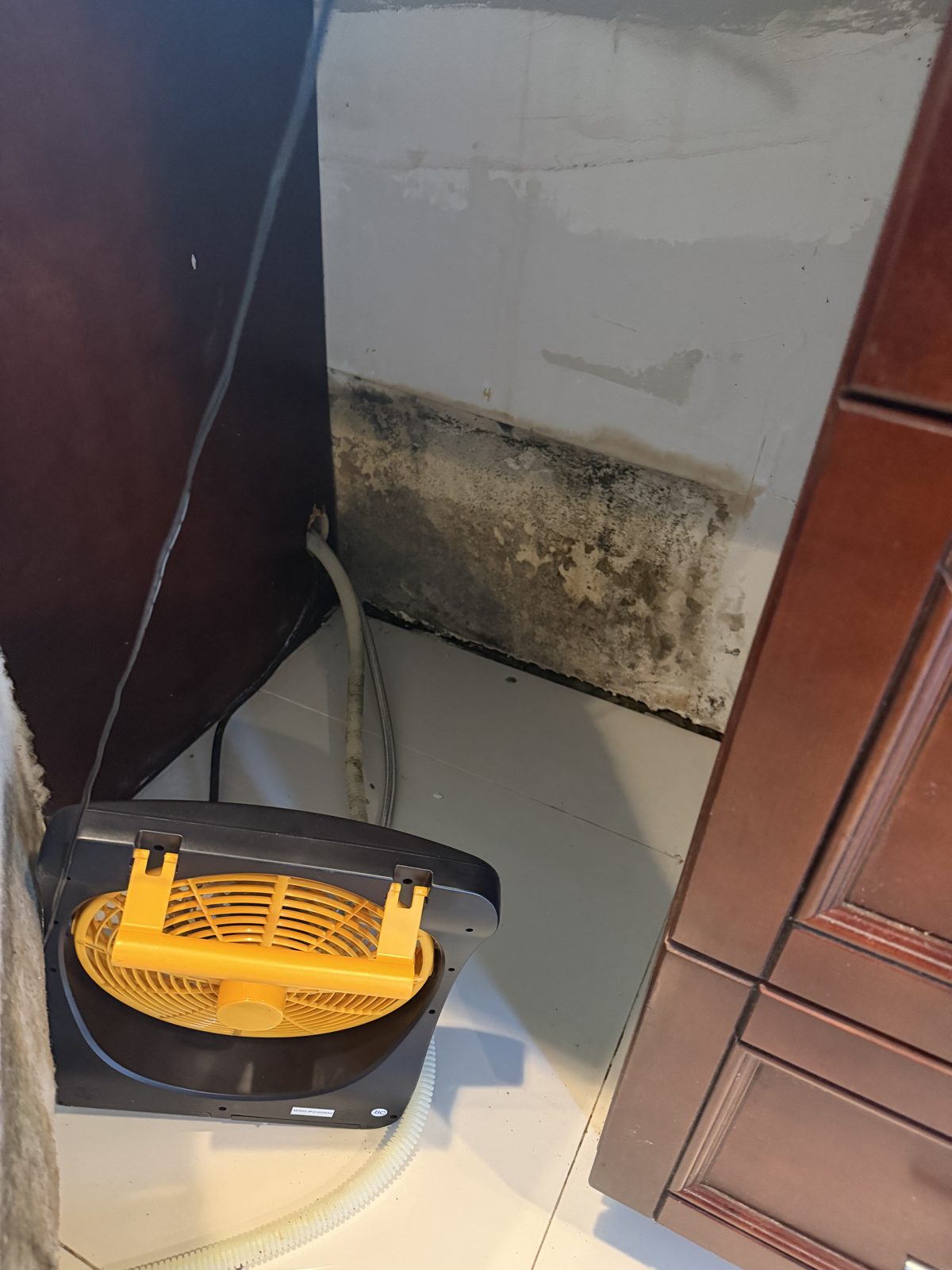
Most of the serious restoration work we do in Deerfield Beach and Pompano Beach between October and January isn’t caused by anything dramatic. It’s a small failure that happened in June in a unit nobody opened until November.
A supply line under a bathroom sink that started to weep. A condensate line that clogged and backed the pan up. A toilet flapper that ran intermittently. In an occupied home, every one of those is a minor repair. In an empty one, it’s five months of water going somewhere.
So the useful thing isn’t a warning about leaks. It’s a sequence — what to do before you leave, and what to look at when you come back, in the order that actually finds problems.
Six things, and the first one does most of the work.
Close the main water supply. A line that isn’t pressurized cannot flood your home. This is the highest-value item on the list by a wide margin. If your building has fire sprinklers, that system runs on a separate line and must stay open — only close the domestic supply.
Put the water heater on vacation mode if you’ve closed the main, or shut it off at the breaker. There’s no reason to keep an empty tank hot for five months.
Leave the AC running. Not off. Set it around 78 to 80 degrees, or use a humidistat or smart thermostat to hold relative humidity somewhere near 55 to 60 percent. This is the difference between coming back to a normal house and coming back to growth on the leather furniture.
Change the AC filter and flush the condensate line before you go. A line that’s already partly restricted in May is a line that’s fully clogged by July.
Open interior doors and closet doors. Air that doesn’t move is where mold starts. Closed guest rooms and closed closets on exterior walls are the two most common spots we find it.
Have someone look in. Monthly is plenty. A neighbor, a property manager, a friend. They don’t need to inspect anything — they just need to open the door and smell.
Do these in order. The order matters more than people expect.
Come in, shut the door behind you, and stand there for a minute before turning anything on and before opening a single window.
A closed house holds its own air, and that air is the best diagnostic you will get all day. A musty or earthy smell means moisture has been sitting somewhere. Once you’ve opened the sliders and run the AC, you’ve flushed the only free piece of evidence you had.
If it smells fine, that’s genuinely good news, and you can move through the rest of this list at a relaxed pace.
Walk every room and look at the ceilings, especially any ceiling underneath a bathroom, a kitchen or an air handler. In a condo, look at the ceilings below the unit above you.
You’re looking for rings, brown or yellow staining, any area where the paint texture looks different, and any spot where the drywall tape seam has started to show.
Get low. Look at the bottom inch of the baseboard around the perimeter of every room, and at the edges where flooring meets the wall.
Swollen baseboard, separation at the bottom, discolored or cupped flooring near a wall, or tile that sounds hollow when you tap it — all of those say water was on that floor at some point.
Every cabinet, every bathroom, the kitchen, the laundry room. You’re looking for staining on the cabinet floor, a swollen or separating toe kick, white mineral crust on a fitting, or any dampness at all on the supply lines and the P-trap.
Run your hand along the back of the cabinet where you can’t see. It’s the spot that hides the most.
Look at the pan under it, the floor around it, and the wall behind it. A slow weep from a tank or a fitting leaves a mineral trail. Water heaters are one of the most common causes of a major loss in these buildings, and they usually give some warning before they let go.
Check the drain pan for standing water and for rust staining that suggests it’s overflowed before. Look at the ceiling or the wall directly below the unit. If the air handler is in an attic or a closet, this is the single most likely source of a problem you’ll find.
Pull it out far enough to see the hoses and the wall behind it. Rubber hoses degrade, and five months of static pressure is a real test. If yours are rubber and more than a few years old, this is a good moment to replace them with braided stainless.
Look at the floor at the base of each one, and at the ceiling of the room below if there is one. Then flush each toilet and watch that it fully stops. A flapper that doesn’t seat runs continuously, and a continuously running toilet has overflowed more than one unit while nobody was home.
Especially on the east side and anywhere facing the water. Storm season happened while you were gone. Look at the bottom corners of the frames, the tracks, and the drywall at the sides of the opening, where wind-driven rain shows up as staining low on the wall.
Three things, in this order.
Photograph it before you move anything. Wide shot of the room, then close-ups. If a cabinet has to come open or a rug has to be pulled back, photograph it before and after. This is the evidence your claim will be decided on, and it stops existing the moment anything gets cleaned up.
Don’t start opening walls. The instinct to see how bad it is behind the drywall is understandable and it’s the wrong move. Cutting into material with active growth releases spores into the rest of the home, which turns a contained problem into a whole-unit problem. This is a real and common way a small job becomes an expensive one.
Find out how far it actually went. What’s visible on the surface is almost never the extent of it. Moisture travels through framing, along the underside of flooring, and into the cavity behind a cabinet run. That’s what a meter and a thermal camera are for, and it’s what a free inspection tells you before anyone quotes a number.
Then, and only then, decide what to do. Sometimes the honest answer is that it’s a surface issue on tile you can clean yourself, and we’d rather tell you that than sell you a containment.
People often ask us to test first. Worth knowing how this works in Florida: mold assessment — the sampling and the written protocol — is a separate license from mold remediation, and in most cases one company isn’t permitted to do both on the same property. That separation is deliberate, and it exists so the company finding the mold isn’t also the company selling you the removal.
We’re remediators, licensed under MRSR5407. When a job needs independent testing or a clearance sample, we bring in a third-party assessor. The longer explanation, including how to verify any Florida license in about a minute, is here.
Two extra things.
If the water appears to have come from above, notify the association in writing right away, and photograph the ceiling before anyone touches it. Two policies are likely involved and the association’s documents will have something to say about which is which.
And don’t wait on the association to authorize drying. Who pays is one question, and whether the wet material dries before it grows mold is a different question with a much shorter clock. Mitigate first, sort out the claim afterward — most policies actually oblige you to.
If you open up a place this fall and something doesn’t smell right, we’ll come look at it for free and tell you what you’re dealing with. We’re owner-operated out of Boca Raton, minutes from Deerfield and Pompano, and we answer 24/7 at (954) 778-0925.
For most homes and condos, yes — closing the main supply valve is the single most effective thing you can do, because a line that isn't pressurized can't flood anything. Two cautions. If your building has a fire sprinkler system, that line is separate and must never be closed; only shut the domestic supply. And if you close the main, switch the water heater to its vacation setting or turn it off, since heating an empty tank is pointless and hard on the unit. Some associations have their own rules about this, so check yours.
The common recommendation is to leave the system running rather than off, set somewhere around 78 to 80 degrees, or to use a humidistat or smart thermostat set to hold relative humidity near 55 to 60 percent. The goal isn't comfort, it's keeping indoor humidity low enough that mold can't establish. Turning the AC off entirely in a closed South Florida house through the summer is how people come back to growth on furniture, in closets and along exterior walls.
Growth on wet porous materials typically begins within 24 to 48 hours. That's why the length of time a leak ran matters far more than how big the leak was. A pinhole that weeps for five months into a closed-up unit does more damage than a burst line caught the same afternoon.
Surface mold on non-porous materials like tile, glass or finished metal can often be wiped down. Porous materials — drywall, insulation, cabinetry, carpet padding — can't be cleaned once mold has rooted into them, and bleach doesn't reach what's growing inside a wall. Cutting into affected material without containment also spreads spores through the rest of the home. For anything beyond a small surface spot, or anywhere you can smell it but not see it, it's worth having someone look before you start opening things up.
It depends on the cause, not on whether you were home. A sudden, accidental failure — a supply line that bursts, a water heater that lets go — is typically a covered cause even if nobody was there to see it. Damage from long-term seepage or a maintenance issue is usually excluded. Where it gets argued is that a covered sudden failure which then sat for months can be characterized by a carrier as gradual damage. Photograph everything before anything is moved or removed, and report it promptly.
Before you turn anything on or open any windows, stand in the entry with the door closed behind you and smell. A closed house holds its own air, and a musty odor is the cheapest and most reliable early signal you'll get. Once you've opened windows and run the AC you've diluted the one piece of evidence that was waiting for you.
Tell us what's going on and we'll get right back to you. Free inspection, and for active emergencies we answer 24/7.
(954) 778-0925Owner-operated · Boca Raton, Palm Beach & Broward · FL Lic #MRSR5407