 PURE SHIELD
If water came into your house from outside, you need flood restoration, and your homeowners policy probably does not cover it. Here is what that means, what the work involves, and what drives the price.
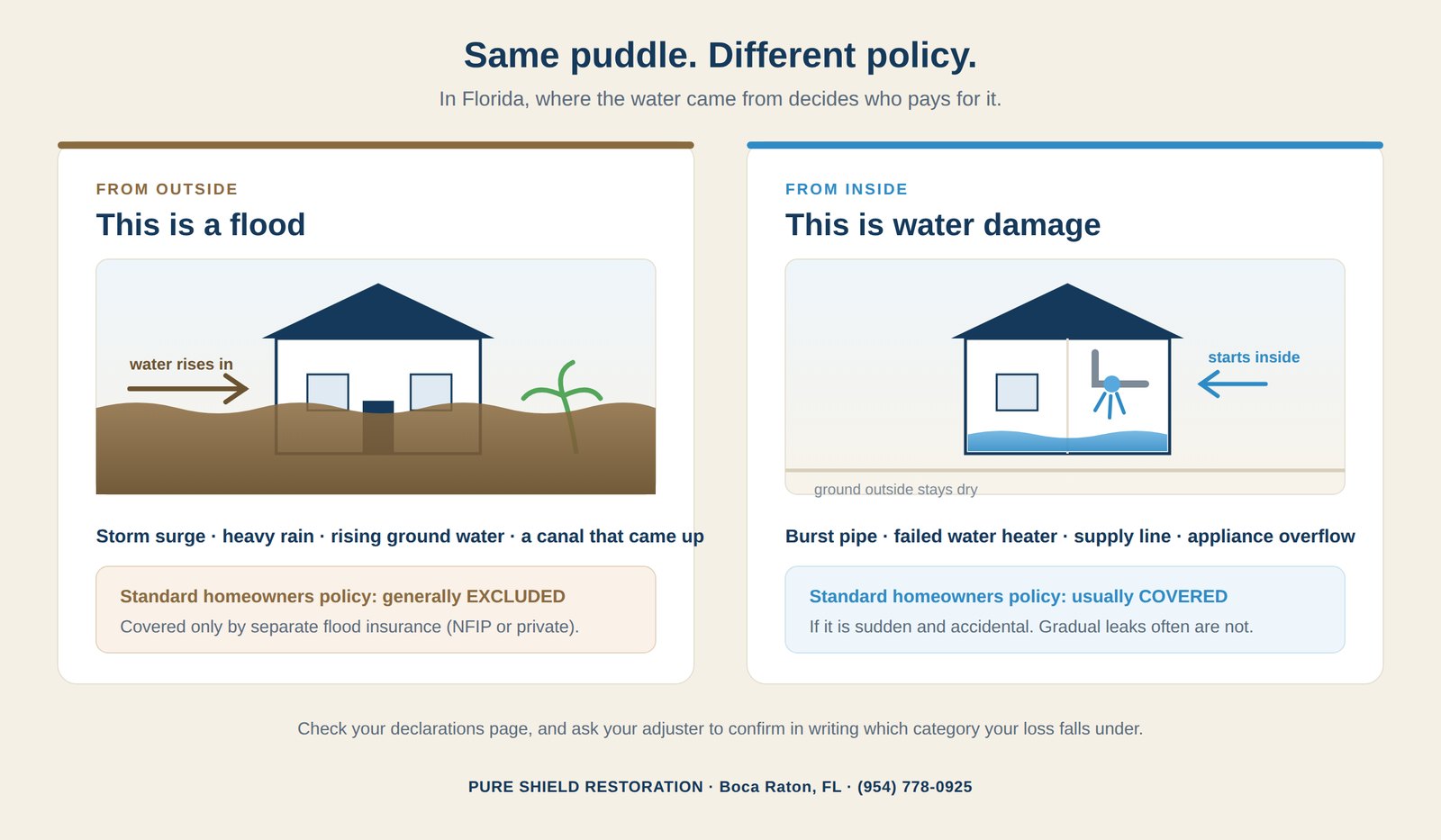
Water on your floor looks the same whether it came in through the door or up from a broken pipe. Where it came from decides who pays for it, and whether you need flood restoration or a standard water damage cleanup. Most South Florida homeowners learn the difference with the water already in the house.
A burst pipe or a failed water heater is sudden water from inside the house, and a standard homeowners policy usually covers it. Water that rises from outside, from storm surge, heavy rain or a canal over its banks, counts as flood, and standard homeowners policies generally exclude it.
You buy flood coverage separately, through the National Flood Insurance Program or a private flood insurer. From the driveway the cleanup looks about the same. The claim goes to a different place, though, and the work inside is a bigger job than drying out a burst pipe.
Restoration crews treat flood water as contaminated from the moment it comes in, however clear it looks. The industry standard we work to, IICRC S500, sorts water into three categories. Category 1 is clean water from a supply line. Category 2 carries some contamination, like a washing machine overflow.
Category 3 is grossly contaminated. Ground surface water and storm surge fall there by definition, because on the way to your house they pick up whatever is in the street, the soil, and the septic and sewer lines.
That category changes what we do on the job:
 Category 1, 2 and 3 water, and what happens to your materials in each.
 Drywall that soaked up flood water comes out. There’s no way to disinfect the inside of it.
If a company treats storm surge like a clean water leak and sets up a few fans, expect to be calling someone else about mold in three weeks.
Nobody can quote a flood job honestly without seeing it, and the size of the puddle matters less than you’d think. These four things move the number most:
 Monitored drying on one of our jobs. The equipment stays until the readings say dry.
 A moisture reading on the wall. These numbers decide when the equipment comes out.
Be wary of a firm price over the phone before anyone has taken a reading. That number is padded to cover what they can’t see, or it’s going to grow later.
In Florida, the company that tests your home for mold generally can’t be the company that removes it. Under Florida Statute 468.8419, a licensed mold assessor may not remediate a structure they assessed within the last twelve months, and a remediator may not assess a structure they remediated in that window.
The rule takes away any reason to find more mold than is there. We explain how it works, and the one exception, in mold inspection vs. mold remediation in Florida.
It also gives you an easy question for any company that shows up: are you the assessor or the remediator? Pure Shield is a licensed mold remediator, license number MRSR5407. We don’t do our own clearance testing. When a job needs independent verification, a third party with no stake in the size of the job handles it.
 Category 3 water calls for a full suit and a respirator. A shop vac won’t cover it.
Answering the phone at 2am is a good start, but check a few more things before you let a crew in. Ask for the Florida license number and look it up. Ask whether you’ll get moisture readings and photos set up for an adjuster, since a claim without documentation turns into an argument later.
Ask who will be on site. With the big franchises, the estimator you meet often isn’t on the crew that shows up. And ask what doesn’t need doing. A company that won’t say no to any part of the job is trying to sell you all of it.
If your water came from inside the house, like an active leak, the coverage question flips and the work changes with it. Our flood and water damage restoration page covers how we handle both.
If mold has already taken hold, you need mold remediation, which Florida licenses separately. Homeowners in Boca Raton can see recent jobs we’ve documented.
Shut off the source if you can reach it safely, and stay out of standing water where the power may be live. Photograph everything before anything moves, because your adjuster will want those photos. Then call for help.
Have these ready when you call your insurer. They keep a claim moving:
Pure Shield Restoration is owner-operated and answers 24/7. Call (954) 778-0925 for a free inspection. We serve Boca Raton and the rest of Palm Beach and Broward, the owners are on every job, and we’ll tell you straight what needs doing and what doesn’t.
Flood restoration is the whole process of getting a property back to normal after water comes in from outside, like storm surge, heavy rain or rising ground water. It covers pulling out standing water, removing materials that can't be dried safely, structural drying, cleaning and disinfecting, and mold prevention. It's a bigger job than a basic water cleanup, because outside flood water is treated as contaminated from the moment it comes in.
Restoration means putting the property back the way it was. Remediation means removing a specific hazard, usually mold, so the place is safe again. A flooded house often needs both. The water damage side is restoration work, and if mold has taken hold you'll also need remediation, which Florida licenses separately.
Usually not. Standard Florida homeowners policies generally cover sudden water from inside the house, like a burst pipe or a failed water heater, but they exclude flood, which means water rising from outside. Flood coverage comes from a separate policy through the National Flood Insurance Program or a private flood insurer. Check your declarations page, and ask your adjuster to confirm in writing which category your loss falls under.
It depends on how much water came in, how long it sat, and how much material has to be torn out instead of dried. A small, contained area that gets a fast response costs far less than a whole floor that sat wet for three days. Anyone who gives you a firm price before seeing the moisture readings is guessing. We inspect first, explain what's driving the number, and put it in writing.
In most cases, not safely. Under the industry standard, outside flood water is Category 3, which means it's treated as contaminated no matter how clean it looks. Cleaning it up takes protective gear, careful removal of porous materials and proper disposal. If you pull up wet carpet yourself and run a household fan, you'll usually leave moisture in the house and mold behind the baseboards.
Ask three things. First, are they licensed and insured in Florida, and will they show you their license number? Second, will they give you moisture readings and paperwork you can hand to an adjuster? Third, will they tell you straight what doesn't need doing? Be careful with anyone who both tests for mold and does the remediation on the same job, because Florida law separates those roles.
Tell us what's going on and we'll get right back to you. The inspection is free.